Datetime: 2026-08-31 08:19:06 Visit: 6581
The oil press is the core piece of equipment in any oil processing operation. Whether daily maintenance is performed properly and wear parts are replaced in a timely manner directly affects the machine's service life and production continuity. For customers new to this industry, understanding the key maintenance points and replacement intervals for wear parts is essential to ensuring long-term, stable operation of your project.
I.Daily Maintenance Key Points
1.Daily Warm-Up
Before starting production each day, the oil press needs a 30 to 60 minute warm-up. Feed the raw material only after the pressing chamber reaches approximately 90°C. At this temperature, the oil flows more smoothly and discharge is more consistent, while also protecting the machine from abnormal wear caused by sudden loading under cold conditions.
2.Temperature Monitoring
During normal operation, the gearbox temperature typically stays around 70–80°C. If you notice the gearbox temperature rising abnormally, shut down the machine promptly for inspection — this may be an early sign of insufficient lubrication or bearing wear.
3.Cleaning and Inspection
After shutdown, promptly clear any residual material from the pressing chamber to prevent it from absorbing moisture and hardening, which could cause jamming on the next startup. Oil stains on the machine surface can be wiped clean with a solvent thinner. Regularly check the hopper, oil tray, and other components for material buildup, and keep the machine clean.
4.Lubrication Maintenance
The lubricant level and quality in the gearbox should be checked regularly. We recommend checking every 3 to 6 months; if the oil has turned dark or the level has dropped, top it up or replace it promptly. For hydraulic presses, replace the hydraulic oil once a year and check for leaks every 3 months.
5.Voltage Stability
Voltage fluctuations have a significant impact on the electrical components of an oil press. The normal allowable voltage fluctuation range is ±5%. Exceeding this range shortens the lifespan of electrical components and causes current fluctuations. If the voltage in your area is unstable, we recommend installing a voltage stabilizer. Additionally, high ambient temperatures (e.g., sustained room temperatures above 30°C) can also affect the electronics inside the control cabinet — keep the cabinet well-ventilated and do not leave it sealed for long periods.
6.Proper Operation
For cold pressing, keep the raw material moisture content around 10%; excessive moisture will prevent the press from operating normally. For hot pressing, maintain the feed moisture at around 2% and keep the chamber temperature at approximately 90°C. Improper operation — such as excessive moisture, overly fast feeding, or insufficient temperature — is a leading cause of abnormal machine wear.
II.Wear Parts Identification and Replacement Intervals
The main wear parts of an oil press include the following categories:
1.Pressing Worm
The pressing worm is the most critical wear part in a screw oil press. Over time, the threads on the pressing worm gradually wear down, reducing conveying efficiency and oil yield. The replacement interval for a pressing worm is typically calculated by processing volume rather than by time. Different press models have different intervals due to varying production capacities.
2.Pressing Rings and Pressing Bars
Pressing rings and pressing bars are key components that form the pressing chamber and are responsible for building pressure inside it. Our oil presses use a pressing-ring configuration — the oil discharge area is formed by both pressing bars and pressing rings. Compared with a pure pressing-bar design, the pressing-ring configuration delivers higher pressure, greater oil yield, and thinner cake, while also being more wear-resistant, producing less residue, and yielding cleaner pressed output. The pressing rings and pressing worm are made of 20# low carbon steel with heat treatment; the shaft is medium carbon steel, and the upper and lower press cages are ductile iron.
Wear on pressing rings and pressing bars mainly manifests as enlarged inner bores and blunted edges. A noticeable increase in residue output or a drop in oil yield is usually a sign that the pressing rings or pressing bars need replacement.
3.Cake Output Ring and Cake Guide Ring
The cake output ring and cake guide ring are located at the end of the pressing chamber, controlling cake thickness and residue output. These two components operate under sustained high pressure and wear relatively quickly. A worn cake guide ring leads to overly thick cake and incomplete oil extraction; a worn cake output ring may cause unstable cake discharge and increased broken cake.
4.Reference Replacement Intervals
The actual replacement interval for wear parts is closely related to the type of oilseed being pressed and the operating method.
Using common oilseeds as a reference:
For the ZX105 pressing rings processing conventional oilseeds, consider replacement after approximately 50 tons of raw material processed.
For the ZX130 pressing rings under the same conditions, consider replacement after approximately 200 tons of raw material processed.
The replacement intervals for the pressing worm, cake output ring, cake guide ring, and other components are similar.
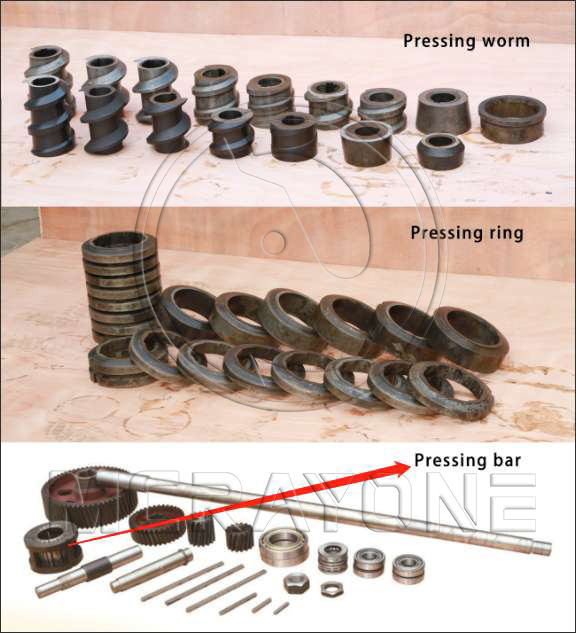
#Wear Parts Display
It is important to note that different raw materials cause vastly different wear rates on wear parts. For example, when processing tung oil seeds, wear parts wear out twice as fast — under normal conditions one set per year, but processing tung oil may require two sets. Shell-bearing materials (such as unshelled palm kernels) also significantly accelerate part wear.
Wear parts have a degree of interchangeability between different models. For example, the pressing rings, pressing worm, and pressing bars of the 105 and 125 models are interchangeable, but the bearings inside the gearbox are not; the bearings on the main shaft are interchangeable.
III.Factors Affecting Wear Parts Lifespan
1.Raw Material Type
Different oilseeds cause varying degrees of wear on wear parts. Materials with high shell content and hard fibers cause faster wear, while high-oil, soft-textured materials cause relatively slower wear. For example, when processing shell-bearing materials such as cottonseed or palm kernels, we recommend upgrading to the next motor size above the standard model; otherwise, parts will wear out very quickly.
2.Raw Material Pre-Treatment
The particle size and cleanliness of the feed material directly affect the lifespan of wear parts. Pressed particles must not exceed 1×2 cm or 1.5×1.5 cm; larger materials need to be crushed first. If hard objects such as stones or metal are mixed into the feed, they will directly damage the pressing worm and pressing rings, causing serious equipment failure.
3.Operating Standards
Accurate moisture control, sufficient warm-up, and uniform feeding speed all affect the wear rate of wear parts. Improper operation often causes the machine to run under overload, accelerating parts consumption.
IV.Wear Parts Sourcing and Stocking Recommendations
1.Stocking Principles
For long-distance customers (such as those in African and South American markets), we recommend purchasing a set of wear part spares at the same time as the equipment. International shipping takes time — if you order only after a part fails during production, you may wait weeks or even longer, and the resulting downtime loss will far exceed the cost of the parts themselves.
2.Material Upgrade Options
Standard wear parts are made of 20# carbon steel. If the raw material you press causes particularly severe wear (such as tung oil seeds or shell-bearing palm kernels), you can opt for 20Cr steel wear parts, which last approximately 1.5 times longer than standard material and cost about 1.5 times the price of standard parts. Whether to choose this option depends on your actual raw material conditions and budget.
3.Proper Storage
Wear parts should be stored in a dry, well-ventilated environment to prevent moisture and rust. Components such as the pressing worm and pressing rings should be coated with anti-rust oil and wrapped in moisture-proof paper before storage.
4.Installation Notes
When replacing wear parts, we recommend having an experienced mechanic perform the work. The installation sequence and tightening torque for the pressing worm and pressing rings must meet specifications — improper installation will affect pressing performance and may even cause rapid damage to the new parts.
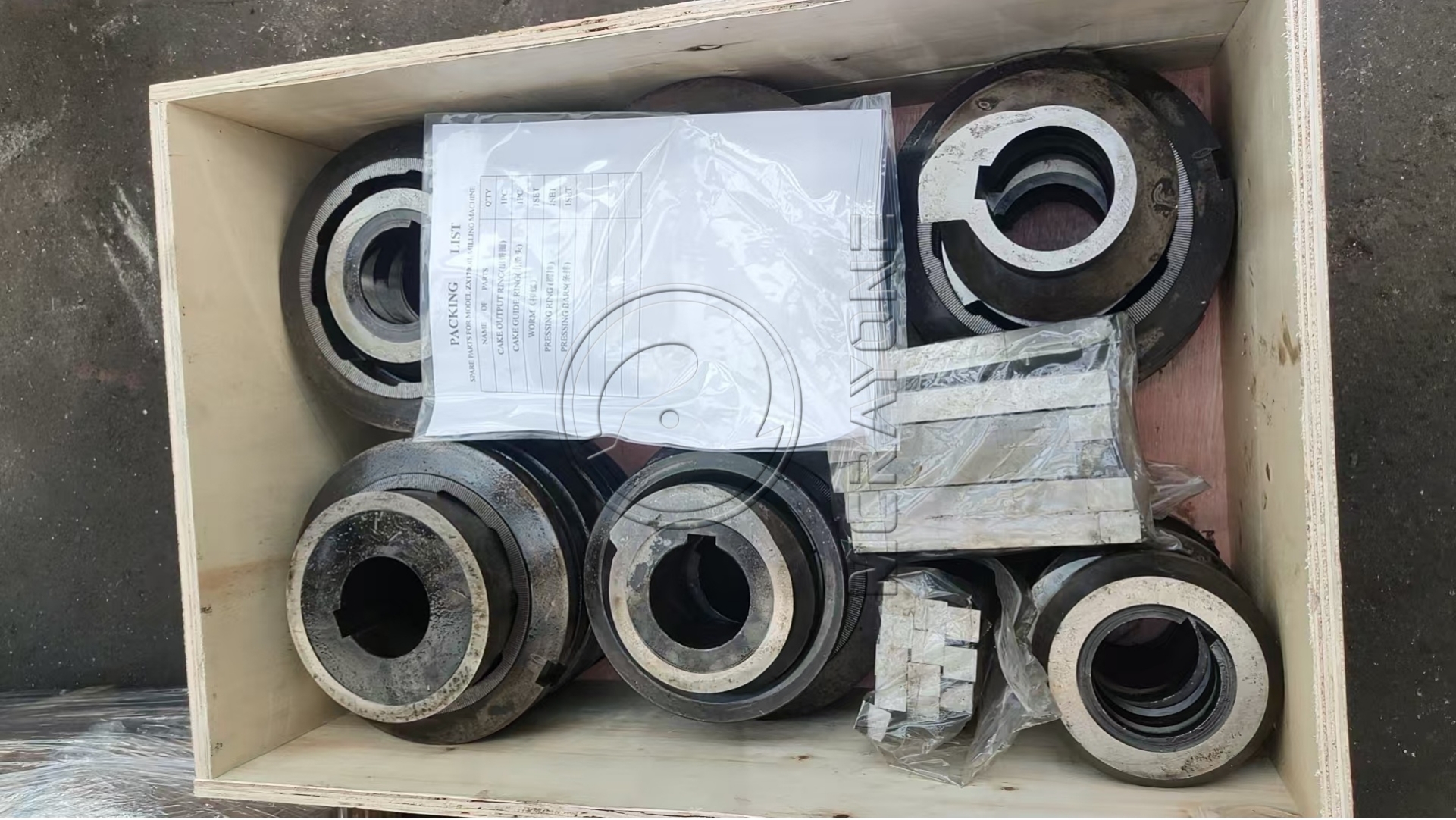
#Wear Parts Packed for Shipment
V.Common Faults and Troubleshooting Guide
|
Symptom |
Possible Cause |
Troubleshooting Direction |
|
No oil or low oil output |
Insufficient chamber temperature, excessive raw material moisture, worn parts |
Check warm-up temperature, test raw material moisture content, inspect pressing worm and pressing ring wear |
|
Excessive residue output |
Worn pressing rings or pressing bars, excessive chamber clearance |
Check if pressing ring inner bores are enlarged, inspect pressing bars for deformation |
|
Abnormally high current |
Overly fast feeding, hard objects in raw material, poor gearbox lubrication |
Adjust feeding speed, check raw material cleanliness, inspect gearbox oil level and quality |
|
Machine vibration |
Loose belt, worn bearings, unstable foundation |
Check belt tension, inspect bearing clearance, reinforce equipment foundation |
|
Unstable cake discharge |
Worn cake output ring, loose cake guide ring |
Check condition of cake output ring and cake guide ring |
Regular daily maintenance and timely wear parts replacement are the keys to ensuring long-term, stable operation of your oil press. Understanding the machine's working condition, knowing the replacement intervals for parts, and mastering basic troubleshooting methods will make production smoother and effectively extend the service life of your equipment.